The cybernetic word processor is for a program for writing, not merely for inserting characters into a file.
I claimed in my previous article, “The Purpose of a System Is How We Shape It,” that our information tools do not properly model the human systems they claim to realize. This means, drawing on the field of cybernetics, that their output collapses rather than bringing about what we wish to create.
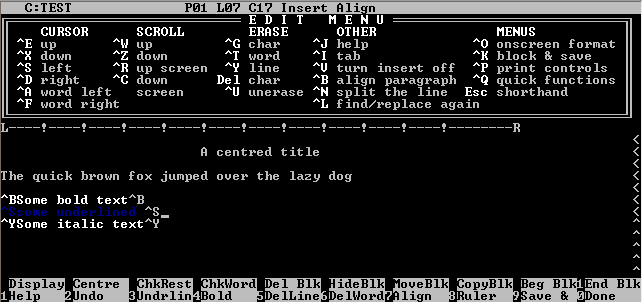
This is to say that writers must fight with modern word processing tools in order to create something good: the natural tendency of these tools is towards confusion and frustration (large, complex projects escape our control and end up abandoned) or towards writing characterized by a lack of overall structure and synthesis.
As a follow-up, I will propose a “cybernetic word processor,” which will give the user full control over all aspects of language (such as morphology, syntax and structure) rather than being merely a tool for inserting characters into files. This, I claim, will allow writers truly to grasp their inspiration and realize their vision.
First: Premises
- In the terms of cybernetics, “viable systems” can maintain a stable internal state; non-viable systems break down or fail. Viable systems, e.g. organisms, can maintain the conditions they need to survive and adapt to continue to do so.*1
- The functional units of viable systems are themselves viable systems. E.g. A cell within an organism maintains its own internal state and adapts to its environment, while being part of a larger system.
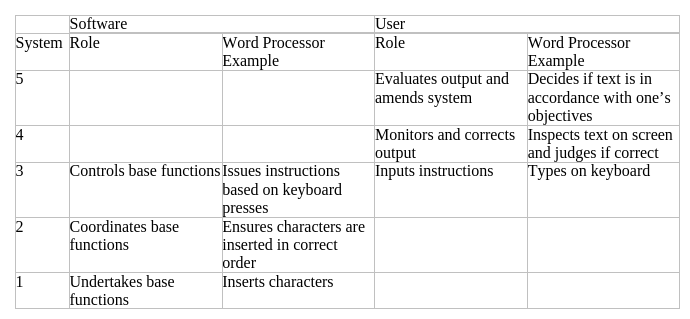
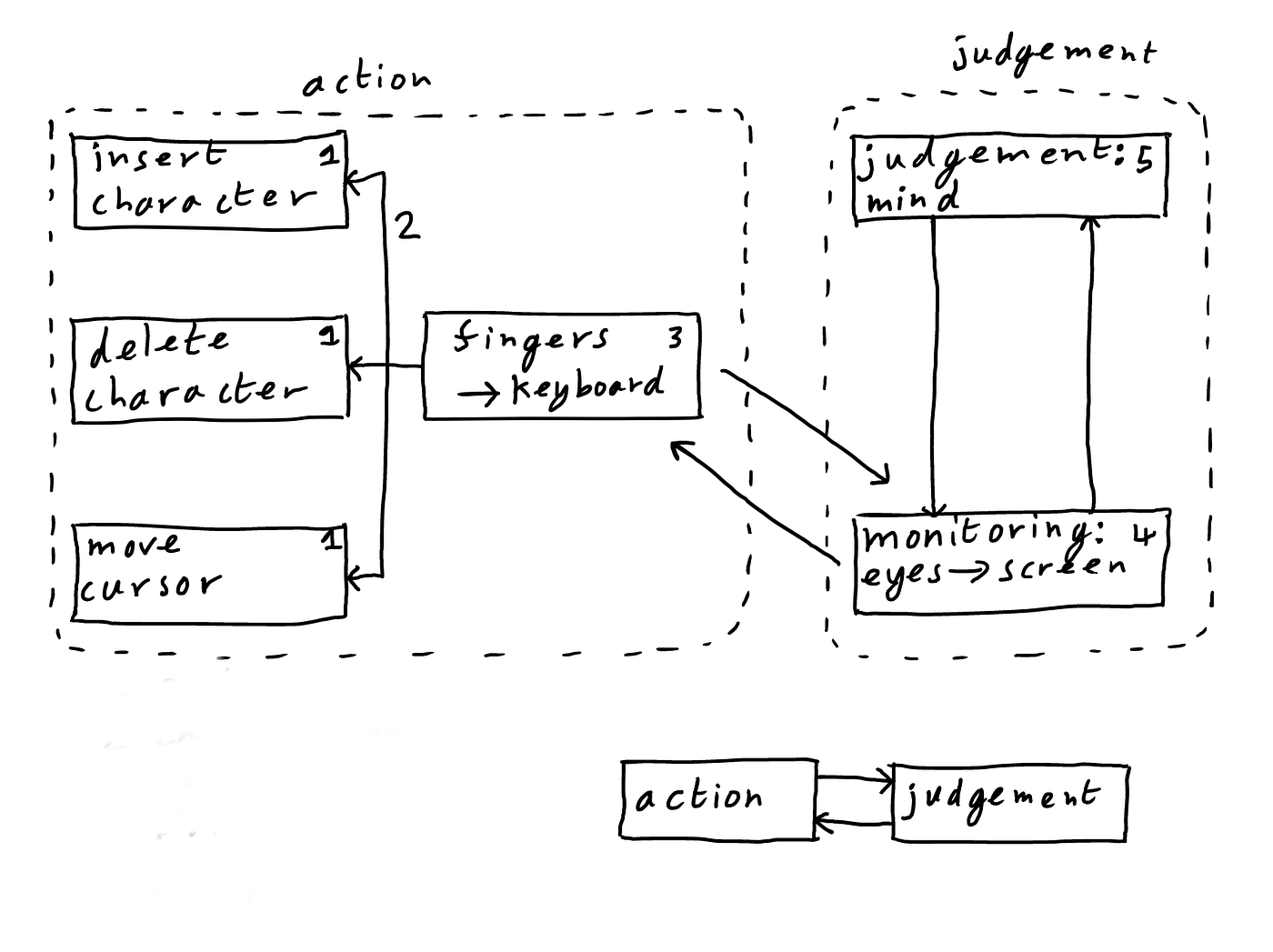
- Viable systems consist of five sub-systems: 1–3 generate the output, 4 monitors and corrects its performance and, 5 amends the system on the basis of information from 4 in order better to pursue the goals at hand.
- Interactive software is — in union with a human user — of interest as a viable system,*2 see an example arrangement below:
For a user to control a system, they must be able to:
- Monitor all the operative parts, on the relevant level of organization, e.g. sentences.
- Affect change, atomically, among said elements.
Fossilized Assumptions
Few aspects of our word processors are sufficient — together with their human operators — to form viable systems. Rather, our information tools essentially give us two viable systems: one for creating files and another for putting characters in said files: between which lies what I call the “neglected middle,” comprising:
- Morphology, which deals with stems, affixes, etc. (e.g. the adverb “independently” consists of the adjective “independent” and the suffix “-ly”)
- Syntax, which deals with the order of words in phrases and sentences
- Structure (a catch-all encompassing the organization of paragraphs, headings and chapters)
We have made some (ultimately unsatisfying) progress. HTML has a construct that corresponds to a paragraph (<p>); Notion has its “block” construct: writers can move blocks and even nest them. Most claimed “headings” in word processors are not so, in that they cannot easily be moved and are not uniquely identified.
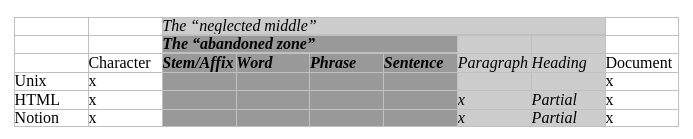
Thus, our information tools give us an electron microscope and stack of atoms for the task of building a car. This task is possible (things being made of their constituents) but neither efficient nor natural. This is also to say nothing of the missing organizational structure above that of the file: publications, archives, anthologies, etc. which are usually represented merely as big files — for the sake of keeping things focused, I won’t go there.
A Cybernetic Word Processor
In practice, any viable word processor should at least afford the writer:
- What is today possible for characters, but on all levels of organization
- The ability — with a single click — to move any element to any location (and even to multiple locations concurrently: Ted Nelson termed this “transclusion”*4; again, for the sake of focus, I won’t go there)
- The ability to “roll up” a given level of organization (e.g. sentences), hiding all but a unique label and enough space to select and move them around
The diagram below breaks down the relevant fields of language, the attendant organizational units, and the relevant systems one might bring to bear.*3
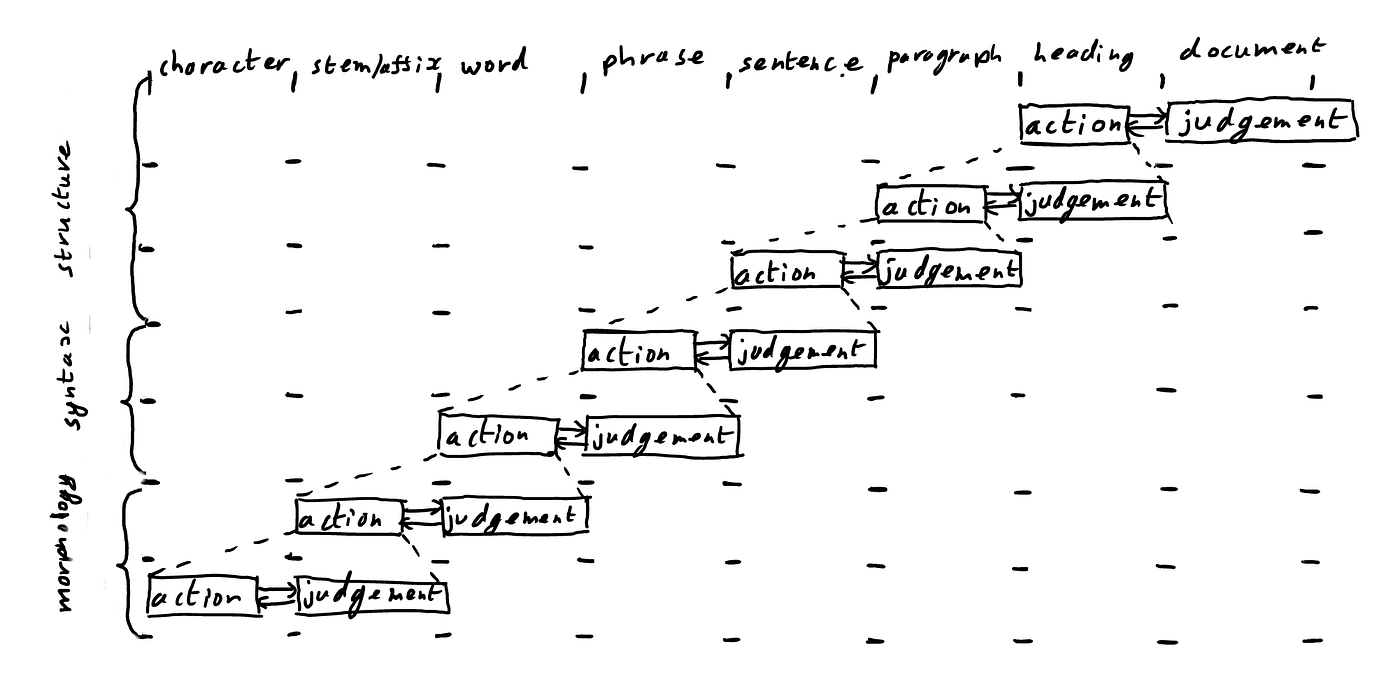
For example, if one is assembling a paragraph, one uses systems 4 and 5 (judgement) to decide which sentences to create and their arrangement, which is brought about by Systems 1 through 3 (action). The exception is of course the character, for which — having no constituents — Systems 1 through 5 operate on the same level of organization.
Here is a little more detail on some (not all) of the above systems:
Word Mode: Insert, delete and edit words, from stems and affixes
Constructing a word need not necessarily require building it from individual characters. Our word processors should allow us a. to construct words morphologically (arranging stems, affixes, etc.) and b. should have seamless dictionary lookup and insertion.
Sentence Mode: Insert, delete and edit sentences, from phrases
Word processors should give us a facility to build sentences grammatically, identifying clauses, phrases and their structure, and giving us relevant choices: whether to start a new sentence or a clause, where in the sentence structure to add material, etc.
Paragraph Mode: Insert, delete and edit paragraphs, from sentences
What does it mean to add a sentence to a paragraph without typing characters? Put it this way: an individual sentence within a paragraph fulfills a particular role (e.g. introducing an idea). We should have facilities therefore to mark the role of any given sentence — both as place-holders for unwritten sentences and as markers for existing ones — thus allowing us to map our ideas and arguments.
Having expounded at length, I must note that:
- The above system applies properly only to English; other languages have similar grammars, some very different: all require their own modes of organization with the same level of fidelity.
- Any such method of organization must be flexible (including an opt out), as we don’t all agree on how English (or any other) grammar actually works.
Version History Tree
Ted Nelson invented this concept, proposing that writing software, as you edit, should create a new version of your work each time you edit after hitting undo — saving the previous most-progressed version (rather than destroying it as most word processors do).*4 This allows the writer to juxtapose versions (System 4) and decide which of them is best or to even combine multiple versions into one (System 5). See a simple example below.

It’s important to note, before concluding, that this outline is just scratching the surface: the cybernetic word processor requires a host of additional and arguably more novel features, e.g. visible links shown between material, the aforementioned “transclusion”, etc. most of which can be traced back to the work of Ted Nelson. Read more about the vision here.
Conclusion
I hold that most of the ills of our online lives — thin writing, political polarization, the absolute obscurity of the big picture — come from the fact that or information tools are not viable: they are at best broken and at worst malicious. Their form is handed down from decades-old computing primitives that don’t bother us because we have never seen otherwise. That which we call new — social media, crypto, artificial intelligence — all manifest the same primitives and a similarly non-viable. They will, therefore, amplify the problems they claim to alleviate.
I doubt you will be surprised to hear that I am building the cybernetic word processor and the software environment of which it is a constituent. I request your feedback, ideas, and collaboration.
- Brain of the Firm, Beer Allen Lane, 1972.
- A computer, on, operating system active but with no user is indeed quite stable, but this is not really the point.
- Provisos: 1. Not all writing is this complex, e.g. some sentences have only one clause/some documents have no headings, obviating those sub-divisions, 2. “Heading” appears only once here, but they can nest to any depth, 3. The recursion can continue above the document, e.g. for sections, magazines, volumes, websites, etc.
- Nelson, T. Computer Lib/Dream Machines, 1977.